How Do You Know When a Download Is a Virus
Vet your visitors before inviting them in.
Checking whether a download is safe earlier you download it is nearly impossible. Your best defence force is your own skepticism, plus anti-malware tools to scan what y'all choose to download.
Someone's pointing me to a downloadable program as solution for a trouble I'g having. I'm really hesitant to download and run unknown EXE files. Is there whatever manner I can scan it with some program or otherwise ascertain if it'due south clean or riddled with subtle spyware, viruses, or whatever else could be bad?
I was somewhat taken aback by this question. It'south a perfectly skillful question, and 1 that more than people should exist request more than often.
My reaction was due to the lack of a good reply.
It turns out it'south fairly difficult to tell whether or not a download is virtually to play havoc with your system, peculiarly before you download it.
Simply information technology's getting better.

In order to be scannable by your anti-malware tool, a questionable file must be able to be read by the tool. That means the file needs to be in the process of downloading, or already be downloaded, to your computer. The all-time way to avoid a problem is to just download from sites and companies you trust, never download illegal software, scan your downloads as soon as yous can, and of grade support regularly in case the worst happens. E'er be skeptical.
What anti-malware tools do
Anti-malware scanners look at the contents of the files on your organization to encounter if they take what appear to be viruses or not. The files don't have to be installed or running; they just take to be attainable to the scanner. You can and should scan that file before you run information technology.
Simply the files exercise have to be on your system, or (in some rare cases) in the process of being downloaded.
Before y'all download? There'southward effectively no solution. You lot have to download it in club to exist able to scan information technology yourself.
What to do?
So, what exercise you lot practice? What do I do, for that matter?
Our all-time defence is to fall dorsum on common sense and best practices for avoiding malware in the kickoff identify.
- Simply download from sites you lot trust. Knowing who to trust is a difficult problem. My recommendation is to avert downloading from third parties. If a slice of software is created by XYZ corporation, download it straight from XYZ corporation'southward website. If information technology'south available directly from the creator, there's no reason to get information technology anywhere else. Avert download sites if at all possible.
- Only download from companies you trust. Fifty-fifty if you do download directly from the creator's website, not all creators are ethical or higher up-board. If you've not heard of the company earlier, it's worth a search to see if other people have experienced bug. A lot of free software is "gratis" because information technology's loaded with PUPs, for case. It might be legal, but it tin certainly be abrasive.
- Never download illegal software. You shouldn't anyhow — considering it's illegal — but even if that doesn't terminate you, the risks should. Illegal software is lucrative considering it'due south gratis or dirt cheap. Malware creators know this and often employ it as an opportunity to distribute their wares.
- Browse your download. This is the like shooting fish in a barrel one. Anti-malware tools can hands and apace browse a downloaded file and tell y'all whether or not it contains any known viruses. Make sure to keep your virus program, and its database, up to date.
- Back upwardly. Fifty-fifty though you may trust what you've just downloaded, prepare for the worst anyway. Assume that what yous're about to install will crusade your machine to crash and become unbootable. Would you lot lose important data? Then you better brand sure it's backed up starting time.
It's getting a little better
I recently downloaded an update to a (legitimate) program I use, and received the post-obit warning:
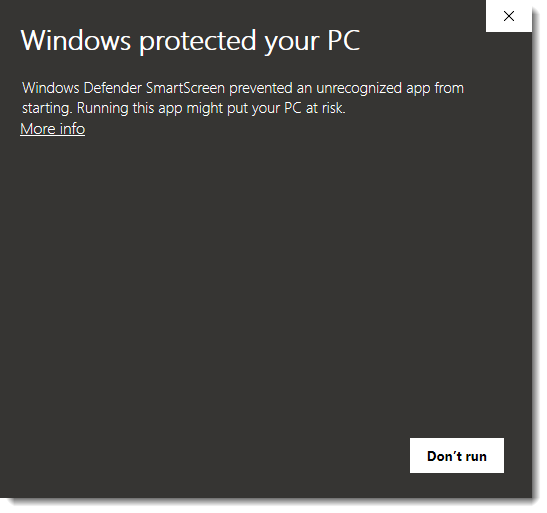
That was Windows Defender warning me that it didn't "recognize" the application I was about to run.
That doesn't mean it'south malware or that in that location'southward annihilation wrong with it at all — it just means that Windows Defender (meaning Microsoft) was unfamiliar with the vendor, or perhaps the software wasn't digitally signed. All it really ways is to take a jiff and consider whether yous recognize and trust the awarding and its vendor. (In this example, you lot can click "More info" which will betrayal a "Run anyhow" button, which is what I used.)
Other security tools use a more than aggressive form of application white-list, meaning merely applications that accept been somehow pre-vetted and confirmed not to exist malicious are allowed to run.
The best advice? Skepticism
In some ways, it'south not surprising malware is as common as it is. Absolute prevention is difficult at all-time. Even with the all-time tools, people ofttimes actively circumventing warnings and other blocks to download whatever they (obviously desperately) want.
Most remedies are zilch more than damage control once malware arrives.
The best defense is you lot. You are both the weakest link and the strongest hope for your ain security. Exist skeptical, take the time, and make the try to cull your downloads with intendance.
Podcast audio
Video Narration


Source: https://askleo.com/how-can-i-tell-if-a-download-is-safe/
0 Response to "How Do You Know When a Download Is a Virus"
Publicar un comentario